Detroit Techno Documentary: How Three Friends Invented Techno (Full Video and Transcript)
A 7 minute 26 second documentary on how Detroit invented techno: the Motor City, the Belleville Three, the Electrifying Mojo, the 808 and 909, Cybotron, Strings of Life, the 1988 album that named techno, Underground Resistance, Berlin and Movement, with chapters and the full transcript.

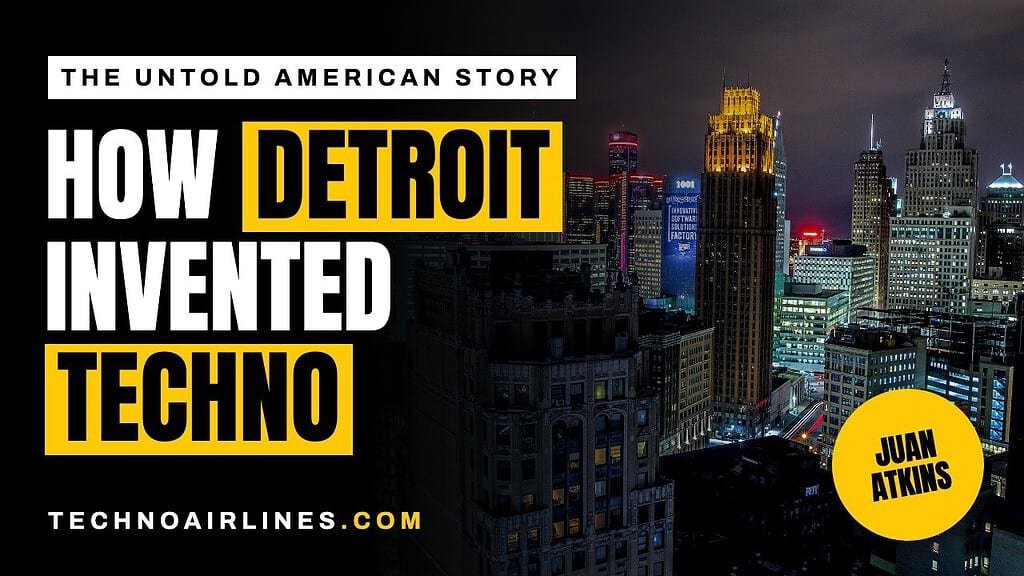
How Detroit Invented Techno is a 7 minute 26 second documentary from Techno Airlines, free to watch on YouTube. It tells how three school friends from Belleville, Michigan, Juan Atkins, Derrick May and Kevin Saunderson, built a new kind of music with second hand drum machines in an emptying car city, how a 1988 compilation gave it the name techno, and how it travelled to Berlin and back home to Hart Plaza. The film is dedicated to Juan Atkins, who died in late 2026 at 64.
Below you will find the film, a chapter guide with timestamps, a timeline of every date it mentions, the people behind the sound and the full narration as text.
The documentary at a glance
| Runtime | 7 minutes 26 seconds |
|---|---|
| Released | 20 November 2026 on YouTube |
| Chapters | 11 |
| Period covered | 1950 to 2026 |
| Narration | English, with dubbed audio in six other languages including German, French, Spanish and Brazilian Portuguese |
| Where to watch | Techno Airlines on YouTube, free |
Chapters and timestamps
Each timestamp opens the film on YouTube at that point.
- 0:00 Intro: Techno fills clubs in Berlin and festivals worldwide, but it was born in an American car city.
- 0:18 Motor City: A city of 1.85 million in 1950, Motown in 1959, the 1967 unrest and the factories leaving.
- 1:03 Three friends from Belleville: Juan Atkins, Derrick May and Kevin Saunderson meet at school; a Korg MS-10 from Juan's grandmother.
- 1:35 The radio: the Electrifying Mojo: The Electrifying Mojo on WGPR from 1977, the Midnight Funk Association and the night he played Kraftwerk.
- 2:10 The machines: 808 and 909: Kraftwerk, Parliament-Funkadelic and two Roland drum machines nobody wanted, the TR-808 and TR-909.
- 2:57 Cybotron: Cybotron with Rik Davis, Alleys of Your Mind in 1981, then Metroplex and Model 500 in 1985.
- 3:42 The hits: Strings of Life and Big Fun: Derrick May's Strings of Life in 1987 and Inner City's Big Fun and Good Life in the UK charts.
- 4:27 The name: techno: The 1988 album Techno! The New Dance Sound of Detroit and the juice-only Music Institute.
- 5:15 Underground Resistance: Mike Banks, Jeff Mills and Robert Hood form Underground Resistance; Planet E and Plus 8 follow.
- 5:50 Berlin: The Wall falls, Tresor opens and its first record comes from Detroit.
- 6:22 Home: Movement festival: The free festival in Hart Plaza from May 2000, now Movement, and Juan Atkins' last set in May 2026.
Timeline: every date in the film
The people in the film
| Who | Role in the story | Key record or moment |
|---|---|---|
| Juan Atkins | The oldest of the Belleville Three, called the godfather of techno | Cybotron, Alleys of Your Mind (1981); Model 500, No UFOs (1985) |
| Derrick May | Belleville Three, founded Transmat | Strings of Life (1987) |
| Kevin Saunderson | Belleville Three, formed Inner City with Paris Grey | Big Fun, UK number 8; Good Life, UK number 4 (1988) |
| The Electrifying Mojo | Detroit radio DJ on WGPR from 1977 | The Midnight Funk Association, playing Kraftwerk |
| Rik Davis | Vietnam veteran, co-founded Cybotron | Clear (1983), Techno City (1984) |
| Jeff Mills, Mike Banks, Robert Hood | Underground Resistance, from 1989 | Faces covered, no major labels; Hood shapes minimal techno |
| Carl Craig | Second wave producer | Founded Planet E in 1991 |
| Richie Hawtin | Across the river in Canada | Founded Plus 8 |
Full transcript
The complete English narration, split by chapter. Timestamps link to the same moment in the video.
Intro (0:00)
Techno fills clubs in Berlin, festivals in Europe and dance floors all over the world. But it was not born in Berlin. It was born in an American car city, made by three school friends with cheap machines. This is the story of how Detroit invented techno.
Motor City (0:18)
In 1950, Detroit is one of the richest cities in America. Almost 1.85 million people live here. Ford, General Motors and Chrysler build cars for the whole world. People call it the Motor City. Its music is famous too. In 1959, Motown Records starts in a small house here. But the factories start to leave the city, and the jobs go with them. In July 1967, the city explodes. After five days of unrest, 43 people are dead. In 1972, Motown moves to Los Angeles. By the late 1970s, large parts of Detroit are empty.
Three friends from Belleville (1:03)
About 30 miles from the city, there is a small town called Belleville. Three teenagers meet at school there: Juan Atkins, Derrick May and Kevin Saunderson. They are among the few Black students in their school, and they quickly become close friends. Juan is the oldest. His grandmother buys him his first synthesizer, a Korg MS-10. He teaches himself to make music alone in his room. Later, the world will call them the Belleville Three.
The radio: the Electrifying Mojo (1:35)
At night, the three friends listen to the radio. Their favourite DJ calls himself the Electrifying Mojo. He starts on a Detroit station, WGPR, in 1977. Mojo does not follow the rules. He plays funk, Prince, new wave and strange electronic music from Europe. His show is called the Midnight Funk Association. At midnight, he asks the whole city to flash its car headlights and turn on its porch lights. And one night, he plays a band from Germany called Kraftwerk.
The machines: 808 and 909 (2:10)
Kraftwerk make music only with machines. Juan Atkins said that when he first heard them, he froze. For him, this is the sound of the future. But he also loves the funk of Parliament and Funkadelic. Now he needs machines of his own. And he is lucky. In 1980, the Japanese company Roland makes a drum machine called the TR-808. It costs 1,195 dollars, and musicians do not like it. It does not sound like real drums. The TR-909 comes in 1983. It also sells badly. Soon, you can buy these machines second hand for very little money. For young producers in Detroit, that is perfect.
Cybotron (2:57)
In 1980, Juan Atkins starts a group called Cybotron with Rik Davis, a Vietnam veteran. The name comes from a book about the future, The Third Wave by Alvin Toffler. In 1981, they release their first record, Alleys of Your Mind. It sells thousands of copies in Detroit. Many people think it comes from Europe. Then come Clear in 1983 and Techno City in 1984. In 1985, Juan leaves the group. He starts his own label, Metroplex, and takes a new name: Model 500. His first record as Model 500 is called No UFOs. Its cold, fast, electronic sound is something new.
The hits: Strings of Life and Big Fun (3:42)
His friends follow him. Derrick May starts a label called Transmat. In 1987, he releases Strings of Life. It begins as a slow piano song, and he makes it fast. The name comes from the Chicago DJ Frankie Knuckles. May describes the music like this: George Clinton and Kraftwerk, stuck in an elevator with only a sequencer. Kevin Saunderson goes a different way. With the singer Paris Grey, he forms Inner City. In 1988, their song Big Fun reaches number 8 in the UK. Good Life reaches number 4. Inner City sell more than six million records. Techno is now bigger in Europe than at home.
The name: techno (4:27)
But this music still has no name. Most people just call it house, like the music from Chicago. In 1988, a British label plans an album of Detroit music. The working title is The House Sound of Detroit. Then Juan Atkins sends in a track called Techno Music. So the album gets a new name: Techno! The New Dance Sound of Detroit. The album does not sell well. But the name stays forever. In the same year, a club called the Music Institute opens at 1315 Broadway. It serves no alcohol, only juice. People come just to dance, until eight or nine in the morning. It closes after only 18 months. But nobody in Detroit forgets it.
Underground Resistance (5:15)
In 1989, a new group appears: Underground Resistance. Mike Banks, Jeff Mills and Robert Hood make hard, fast, angry techno. They cover their faces. They say no to big record companies. Jeff Mills becomes one of the greatest techno DJs in the world. Robert Hood strips the sound down to almost nothing. People call it minimal techno. Carl Craig starts his label Planet E in 1991. And across the river in Canada, Richie Hawtin starts Plus 8.
Berlin (5:50)
In 1989, the Berlin Wall falls. Young people there dance in empty buildings, and they need a sound. They find it in Detroit. In 1991, the club Tresor opens in an old bank vault in Berlin. The first record on the Tresor label comes from Detroit, from Underground Resistance. Detroit DJs start to play in Berlin. Jeff Mills even moves there. A sound from an empty American city becomes the sound of a new Europe.
Home: Movement festival (6:22)
For years, techno is more famous in Europe than in the city that made it. That changes in May 2000, with the first Detroit Electronic Music Festival. It is free, it is in Hart Plaza, in the middle of downtown, and huge crowds come. Today the festival is called Movement. About 30,000 people come every day. By 2020, Detroit has only 639,000 people. But its music is everywhere. In May 2026, Juan Atkins played at Movement one more time. A few months later, in late 2026, he died. He was 64 years old. People called him the godfather of techno. He was a teenager with a cheap synthesizer, in a city that the world forgot. And he gave that world a new kind of music. Next time you hear a techno beat, remember where it comes from. Detroit.
The TA view
The detail that stays with us is the price tag. The machines that built techno were flops, sold off cheap, and that is the only reason teenagers in a shrinking city could afford them. Techno was the sound of the future made from the leftovers of the present, and it took Europe to tell Detroit what it had. Movement in Hart Plaza is where it finally came home.
Frequently asked questions
Where can I watch the Detroit techno documentary?
It is free on the Techno Airlines YouTube channel and embedded at the top of this page. The film runs 7 minutes 26 seconds, has eleven chapters and offers dubbed audio in six other languages, including German, French and Spanish, through the YouTube audio track menu.
Who are the Belleville Three?
Juan Atkins, Derrick May and Kevin Saunderson, three friends who met at school in Belleville, Michigan, about 30 miles from Detroit. Atkins made Cybotron and Model 500, May released Strings of Life in 1987 and Saunderson took Inner City into the UK top ten in 1988.
Why is it called techno?
In 1988 a British label planned an album of Detroit music with the working title The House Sound of Detroit. Juan Atkins sent in a track called Techno Music, and the album became Techno! The New Dance Sound of Detroit. It did not sell well, but the name stayed.
Is there a techno festival in Detroit?
Yes. It started in May 2000 as the free Detroit Electronic Music Festival in Hart Plaza and is now called Movement, with about 30,000 people a day. Juan Atkins played there one more time in May 2026.
Read and watch next
- The history and impact of Detroit techno
- Juan Atkins, Detroit techno pioneer, dies at 64
- Movement Detroit 2027: dates and tickets
- Berlin techno documentary: how a bank vault started it all
- Ibiza documentary: how a quiet island became the party capital
- All Techno Airlines documentaries and videos
Image and footage credits: Photos via Wikimedia Commons: Angie Linder, Angie Schwendemann, Brandon Daniel, Andy Miah, emperley3 (CC BY-SA 2.0); Michael Barera, Peter Kersten, PeRshGo, Andrew Jameson, ΛΦΠ, ThatChickOverThere, Rubens Ben, Lrgjr72, Nheyob, Ken S Three, Derek Gauci, Sven Volkens, Myself248, Chris Woodrich, Crisco 1492, Alecothegecko (CC BY-SA 4.0); Andrew Jameson, Albert duce, Ventolin (CC BY-SA 3.0); Phil Cherner (CC BY-SA 2.5); Dave Walker, jandbstartaparty, kevin (CC BY 2.0, CC BY-SA 2.0); 1904.CC (CC BY 4.0); Joe Clark, U.S. National Archives (Public domain). Video: "Detroit views" by Usmiech (Wikimedia Commons, CC BY-SA 4.0); "Detroit: City on the Move" (1965) and Ford Motor Company films, Prelinger Archives (Public domain); Mixkit. Some footage is illustrative. The thumbnail uses images from the same sources.